top of page

NEWS

Editorials and Press Releases

Search

By Johnny Hawke


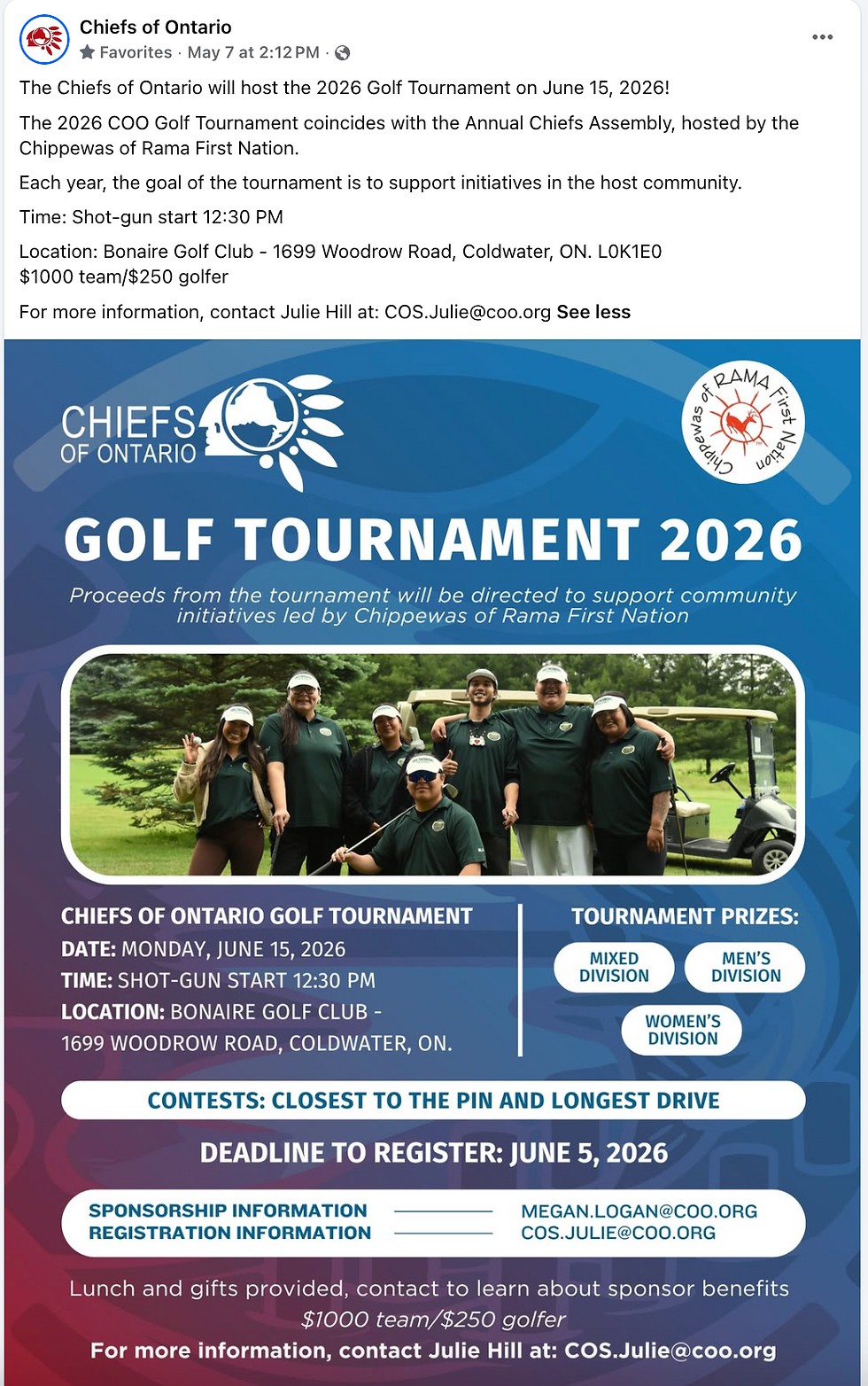
The Chiefs of Ontario is now advertising its annual Golf Tournament where the stated goal of this event each year is to support initiatives in the host community.


The host community this year is Chippewas of Rama First Nation — a community that already operates and benefits from one of the largest casinos in Canada. The Golf Tournament is also being held in Coldwater On which is within the broader territory connected to the Chippewa Tri-Council communities of Rama, Beausoleil, and Georgina Island.


I am from so-called Beausoleil First Nation and this past week I have personally filed three self-represented motions in Federal Court seeking injunctions against projects impacting our lands and treaty rights: a nuclear enhancement project, the transfer of Wasaga Beach Provincial Park to a Township, and a municipal development project.


These matters directly affect rights affirmed under the 2018 Williams Treaties Settlement Agreement between the Province, Canada, and the seven Williams Treaty First Nations, rights which are also protected under Section 35 of the Constitution Act, 1982.


I filed these motions myself because many Chiefs from these communities continue to stand by without aggressively pushing governments and corporations to fulfill their legal Duty to Consult obligations in these specific projects in our Territory.


So while golf tournaments, banquets, and corporate networking events are promoted as “supporting the community,” grassroots people on the frontlines protecting land, water, treaty rights, and future generations are often left without meaningful legal support or representation.


If these fundraising initiatives truly exist to support the people, then where is that support when community members are forced to self-represent in Federal Court to defend collective rights that leadership should already be fighting to protect?


INDIANS AND GOLF

Golf culture within Indigenous political organizations is often defended on the basis that tournaments raise money for scholarships, youth programs, cultural initiatives, sports teams, and other community causes. However, from a radical Indigenous and anti-capitalist critique, the fundraising benefits do not outweigh the deeper political and cultural problems embedded within golf’s corporate and bourgeois character.


Golf has historically functioned as a symbol of wealth, exclusivity, colonial privilege, and executive networking culture. Within Indigenous political spaces, golf tournaments can become environments where Chiefs, consultants, government officials, mining executives, lobbyists, and corporate actors build informal relationships outside meaningful public accountability. Critics argue this creates a comprador-style Indigenous political class increasingly integrated into settler-capitalist systems rather than remaining grounded in community struggle and traditional accountability structures.

1990 "Oka Crisis" where armed conflict was instigated by the expansion of a Golf Course on Burial Grounds in Kanehsatake Mohawk lands.

From this perspective, the issue is not merely recreation or fundraising itself, but the normalization of elite political culture and corporate proximity within Indigenous governance. The concern is that reliance on these spaces compromises neutrality, weakens resistance to corporate interests, and distances leadership from grassroots realities such as housing insecurity, addiction, unsafe water, youth suicide, poverty, and land defense struggles.


Critics also point out that communities are often told controversial fundraising environments are acceptable because they “benefit the community,” yet similar arguments are used to justify alcohol-centered fundraising events despite the well-known harms alcohol has caused in many Indigenous communities through colonial displacement, intergenerational trauma, and addiction.


Golf tournaments frequently intersect with this same culture of corporate sponsorship, alcohol consumption, executive leisure, and political networking, reinforcing what some view as a performative model of leadership disconnected from ordinary people.

The symbolism becomes even more politically charged when considering the historical relationship between golf courses and Indigenous land conflicts.


1990 Siege of Kanehsatake, Land Defenders man barricades to protect Burial Grounds from expansion of a Golf Course.

The Oka Crisis itself was sparked in part by the proposed expansion of a golf course onto disputed Mohawk burial grounds and territory. For many Indigenous activists, this remains a powerful example of how elite recreational spaces, corporate land interests, and colonial governments have historically been prioritized over Indigenous sovereignty, sacred sites, and community rights.


Under this critique, golf tournaments are not viewed as politically neutral community events, but as symbols of assimilation into colonial bourgeois norms — where access to power, status, and corporate acceptance increasingly replaces grassroots accountability, land-based values, and collective responsibility.


PRESS RELEASE

FOR IMMEDIATE RELEASEApril 13, 2026

Indigenous Treaty Rights-Holder Files Federal Court Injunction Motion Over Treaty Concerns in Tiny Township and Wasaga Beach


Christian Island, Ontario — John Courtney Hawke, a Beausoleil First Nation rights-holder from Christian Island, has filed an urgent Motion Record in the Federal Court of Canada seeking an interlocutory injunction to halt development activities connected to two major projects in Simcoe County: the Tiny Township Administrative Centre project and the transfer and redevelopment of lands formerly within Wasaga Beach Provincial Park.

The Federal Court file number is T-1760-26.


The motion alleges that ongoing and proposed land disturbance may result in irreversible harm to endangered species habitat and fish habitat protected under federal law, and that the Crown has failed to fulfill constitutional and statutory obligations, including consultation duties under section 35 of the Constitution Act, 1982.


The motion names the Attorney General of Canada and the Attorney General of Ontario as Respondents.


Mr. Hawke states that the matter engages federal jurisdiction through the Species at Risk Act, the Fisheries Act, and the Migratory Birds Convention Act, and argues that federal decision-makers have a legal responsibility to prevent harm to endangered species and habitat.

The motion materials include evidence referencing the presence of Forked Three-Awned Grass (Ice Age Grass) near the Tiny Township project site, and the importance of Wasaga Beach shoreline habitat for the endangered Piping Plover, a federally protected species.

Mr. Hawke also states that the lands at issue fall within the historic treaty territory of the Chippewas of Lakes Huron and Simcoe, including lands connected to Treaties 5, 16, and 18, and that unresolved historical grievances remain outstanding.


According to Mr. Hawke, the Federal Court has accepted the filing, and both the Attorney General of Canada and Attorney General of Ontario have acknowledged service and advised they will appear.


“This is not just an environmental issue — it is a constitutional issue,” said Hawke. “The law must apply equally. If Indigenous communities are forced to stop projects for species-at-risk protections, municipalities and governments must be held to the same legal standards.”

Mr. Hawke is requesting that the Federal Court issue an urgent interlocutory injunction preserving the status quo until the underlying judicial review is determined.

Media Contact


John Courtney HawkeBeausoleil First Nation Rights-Holder (Self-Represented Litigant)Christian Island, OntarioEmail: communications@anishinaabek.net 705 247 2120


ATTACHED IS THE FILED MOTION RECORD


FOR IMMEDIATE RELEASE


Beausoleil First Nation — March 24, 2026 — John Hawke, an Anishinabek rights holder from the Chippewas of Lakes Huron and Simcoe (Beausoleil First Nation, Chippewas of Rama, Chippewas of Georgina Island), has filed an urgent motion in Federal Court seeking immediate injunctive relief to halt ongoing and proposed developments on lands subject to historic treaties and unresolved land claims.


The motion names the Attorney General of Canada and the Attorney General of Ontario as Respondents and raises serious constitutional concerns regarding the protection of Aboriginal and Treaty rights under section 35 of the Constitution Act, 1982. Hawke is seeking interlocutory injunctions to:


• Stop the Township of Tiny from proceeding with the Tiny Administration Complex project at 255 Concession 9 East;


• Prevent the Province of Ontario from transferring lands within Wasaga Beach Provincial Park to the Town of Wasaga Beach.


The filing argues that these actions are being carried out without meaningful consultation with the Indigenous rights holders, as required under Canadian constitutional law and established Supreme Court of Canada jurisprudence.


“This case is not about stopping development permanently,” said Hawke. “It is about ensuring that development follows the Constitution and respects the Treaty rights that continue to exist on these lands.”


The motion asserts that the lands in question fall within the territories governed by historic agreements, including the Penetanguishene Treaty No. 5, the Lake Simcoe–Lake Huron Treaty No. 16, and the Lake Simcoe–Nottawasaga Treaty No. 18. It further highlights that these lands are subject to an unresolved historical land claim acknowledged by Canada’s Specific Claims Branch.


According to the application, allowing development and land transfers to proceed without consultation risks causing irreparable harm, including: • Destruction of culturally and spiritually significant sites;


• Loss of hunting and harvesting areas;


• Permanent damage to constitutionally protected Treaty rights.


The motion relies on established legal principles, including the duty to consult and accommodate, the Honour of the Crown, and the legal test for injunctions set out in RJR-MacDonald Inc. v. Canada (Attorney General).


Hawke argues that the balance of convenience favours granting the injunction, as the potential harm to Indigenous rights is irreversible, while the Respondents would face only temporary delays.


“This is about upholding the rule of law, the Constitution, and the commitments made between the Crown and Indigenous peoples,” Hawke added. The motion has been filed on an urgent basis, with the Applicant requesting that the Federal Court hear the matter at the earliest possible opportunity.


Media Contact: John Hawke communications@anishinaabek.net

705 247 2120 


  • Facebook
  • Twitter
  • YouTube

Subscribe to Our Newsletter

Thanks for submitting!

CONTACT >

Anishinabek Clans to Invoke our Nation      81 Ogema Miikaan

Christian Island Indian Reserve No. 30a, Tiny, ON, Canada

T: 705 247 2120

C: 705 247 2120

E: communications@anishinaabek.net 

© 2023 by Make A Change.
Proudly created with Wix.com

bottom of page